KAPUTTE REISSVERSCHLÜSSE UND ANDERE NEUE BILDER - Jiří Georg Dokoupil
Images of the Exhibition
Description
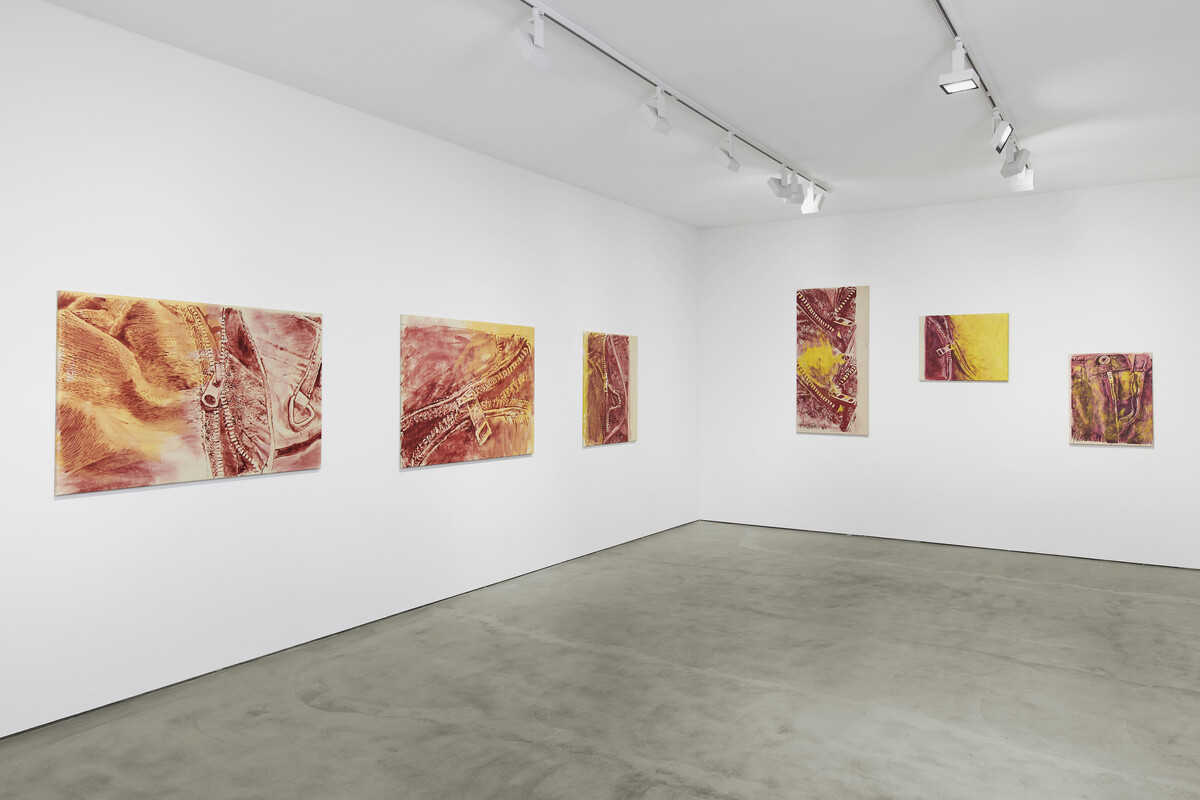
With the exhibition Kaputte Reißverschlüsse und andere neue Bilder, Galerie Wolfgang Jahn presents a solo exhibition by Jiří Georg Dokoupil in Munich that offers a concentrated insight into his current artistic practice. At its center is a new body of work from 2026, shown publicly for the first time, devoted to a motif that is as inconspicuous as it is revealing: the broken zipper.
Dokoupil’s oeuvre has always been marked by a rigorously serial mode of working and a pronounced spirit of experimentation. In ever new approaches, he explores the possibilities of painterly expression, in terms of content, motif, and style, as much as through his choice of often unconventional techniques. Alongside classical methods, he employs soot-producing candles, soap foam, or alkaline solutions as carriers of pigment, incorporates physical interventions such as spitting onto the canvas, or subjects painted surfaces to deliberate processes of transformation in washing machines. The montage of cinematic image sequences onto a single canvas likewise points to his interest in the interweaving of stillness and movement, and in the representation of time within the image.
Against this background, the series Broken Zippers can be understood as a specific approach within Dokoupil’s multifaceted practice, oscillating between diverse painterly and process-oriented methods. In these works, Dokoupil turns his gaze toward an object that ordinarily escapes notice in everyday life and only enters consciousness at the moment of its failure.
The broken zipper functions here as a pars pro toto. As an apparently marginal detail, it has the power to render an entire garment dysfunctional. In this shift from the inconspicuous to the disruptive, a moment of irritation emerges that fundamentally alters the perception of the motif.
Formally, the works focus on the characteristic structure of the zipper itself. Working predominantly within a tonal palette of browns, reds, and yellows, Dokoupil develops a visual language that oscillates between painterly density and graphic reduction. Hatching, rhythmically applied shading, and an emphatic linearity lend the toothed elements a peculiar, almost relief-like plasticity. The interlocking segments appear at once as precisely articulated forms and as fragile structures whose order no longer seems entirely stable.
This latent instability intensifies at the moment of disruption. The zipper jams, the mechanism falters, the connective structure begins to dissolve. What was conceived as a functional system starts to drift apart. The pictorial framing varies between close-up views that fill the format and fragmentary compositions; frequently, the motifs appear against neutral, almost emptied backgrounds that further heighten their isolated presence.
At the same time, this isolated intensification of the motif opens up iconographic associations. Distant echoes may be discerned of the album cover Sticky Fingers, designed by Andy Warhol in 1971 for the Rolling Stones, depicting the cropped lower torso of a man in tight jeans fitted with a real, functioning zipper. Yet whereas Warhol foregrounded a playfully sexualized charge, Dokoupil fundamentally shifts the emphasis. The broken zipper that can no longer be closed generates not desire, but irritation and unease.
This unease points beyond the iconographic level toward deeper layers of meaning. The exposed, tooth-like structures that evade control may associatively recall archaic visual imaginaries such as the motif of the vagina dentata, the widespread cultural notion of a toothed female sex, in which fantasies of threat and vulnerability converge. In the context of the zipper, situated in immediate proximity to a particularly sensitive and potentially vulnerable part of the body, this association acquires an additional latent dimension, especially from a male perspective.
This impression is intensified by the specific painterly treatment. Estrangement effects such as the sepia-inflected palette, gestural overpainting, and the fragmentation of the motif create a visual distance through which the familiar simultaneously appears uncanny. While the object remains recognizable, its clarity is destabilized and opened to further readings.
Within the tension between everyday familiarity and estrangement, a broader interpretation emerges. The zipper appears as an element that both separates and connects. In its dysfunctional state, it becomes a metaphor for blocked processes, for situations in which movement stalls and existing connections can neither be undone nor newly formed. Without fixing the works to a single interpretation, they may be read as reflections on fragile systems of order whose ruptures become visible without being repairable.
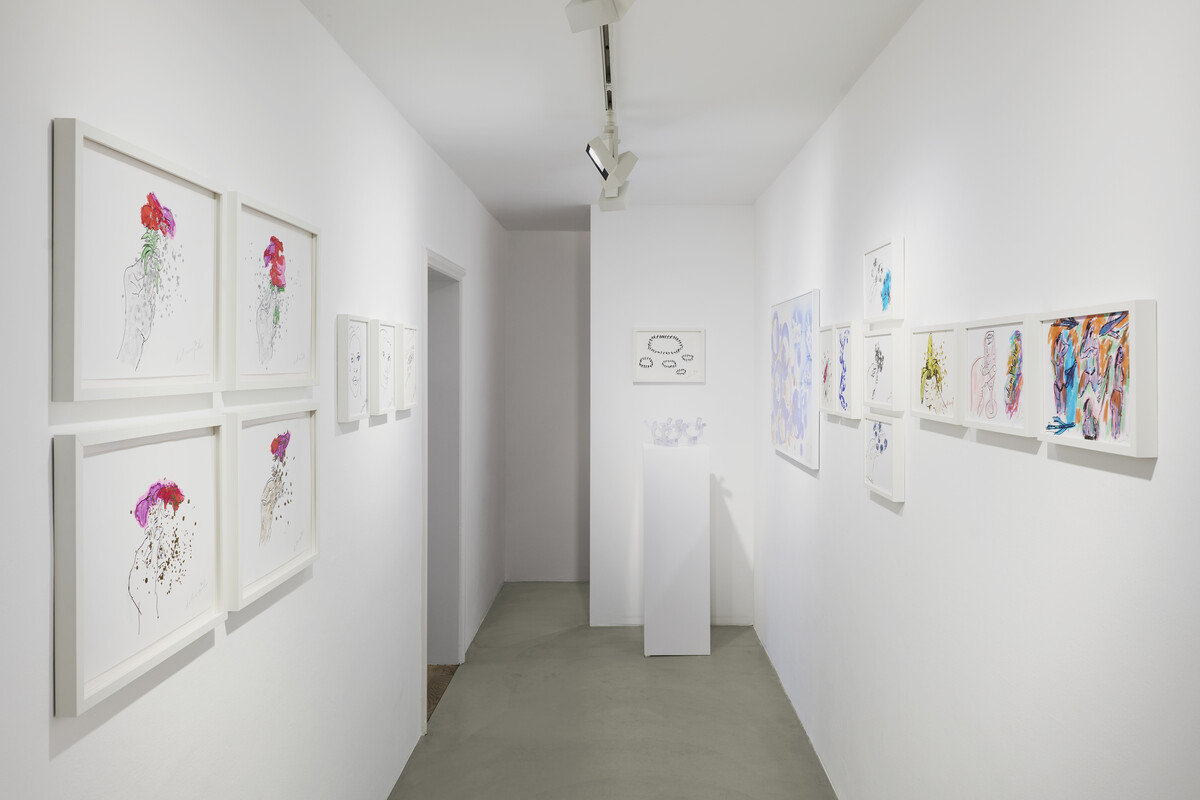
Beyond the Broken Zippers series, the exhibition offers further insights into Dokoupil’s richly varied practice. Within the presentation, these works enter into dialogue with other serial groups in which the artist experiments with unconventional painterly materials such as pigment-infused soap solution. In one sequence of works, he colors the soap foam with the intensely red dye cochineal, also known as crimson or carmine. The extraction of this pigment dates back to centuries-old pre-Columbian traditions; for a long period, it was regarded as one of the most precious coloring agents.
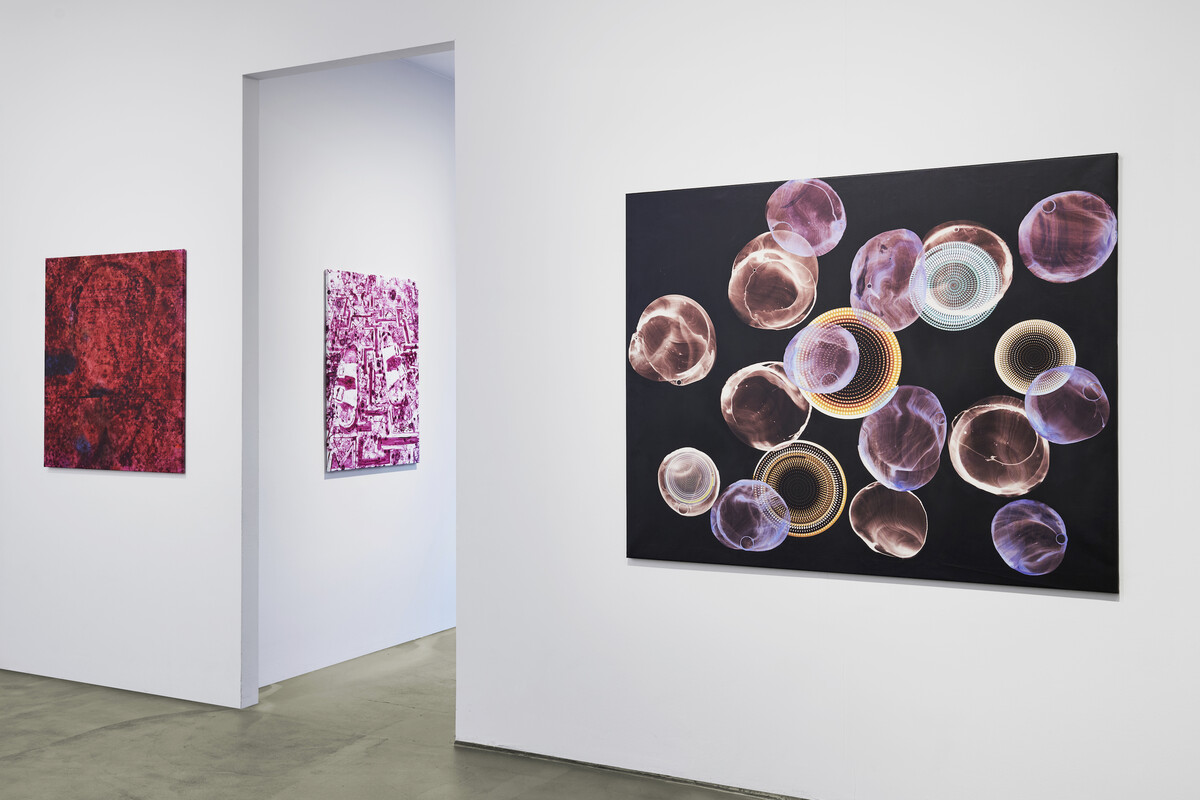
Through blowing and carefully directed painterly gestures, Dokoupil creates an all-over composition of varying chromatic intensities. The liquid pigment settles into droplet-like, cellular formations whose edges retain the dried remnants of soap bubbles. Foreground, middle ground, and background dissolve into a nebulous field of color from which pictorial motifs seem to emerge almost out of nowhere, whether the now iconic portrait of the communist leader and dictator Mao Zedong or a group of flamingos. The motifs appear side by side with startling immediacy, their indistinct presence resembling dream images or memories surfacing in a twilight state from the depths of both collective and personal memory. The nuanced tonalities immerse the visual field in an atmosphere associated with the color red. Art-historical resonances likewise become apparent, ranging from Andy Warhol’s iconic portraits of Mao from 1972–73 to an early text work by Sigmar Polke from 1966.
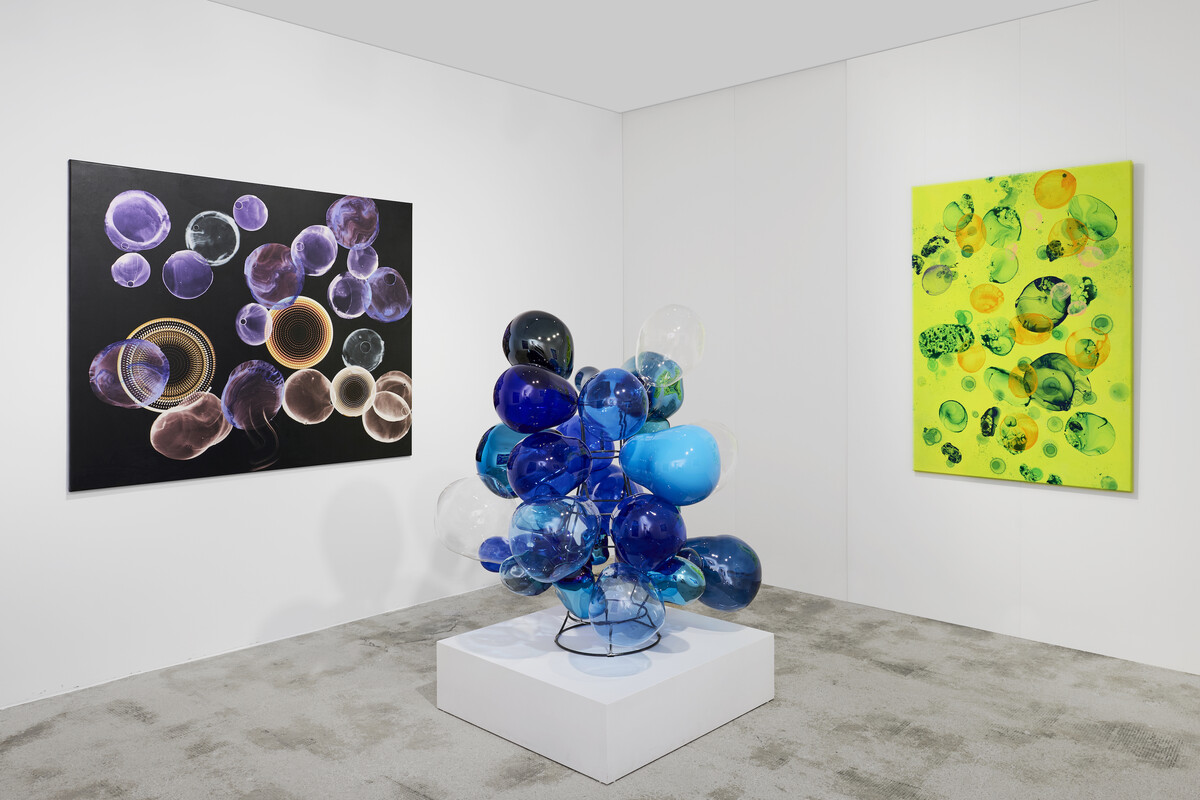
Works from Dokoupil’s Soap Bubble series, long regarded as a kind of artistic signature, are also included in the exhibition. Here, the artist mixes soap solution with various pigments and allows individual bubbles, created by means of a ring, to fall directly onto the primed support, where they burst and inscribe themselves without painterly mimesis. The result is a shimmering, pulsating structure in which marbled chromatic swirls overlap in vivid contrast. The fragility of their appearance becomes inscribed into the image just as much as the ephemeral nature of their existence and the dynamic transformation of their forms.
Dokoupil combines some of these works with chromatically shifting patterns composed of individual elements arranged in concentric circles, forming an aesthetic and formal counterpoint to the freely expanding bubble structures. Upon closer inspection, however, this structure reveals itself to be a reproduced strip of film arranged in a circular formation, consisting of the continuously changing frames of a moving sequence. Visible are harrowing images of a nuclear mushroom cloud following the detonation of an atomic weapon, overlaid with the burst bubble forms into a composition that is at once disturbing and formally mesmerizing. Here, the fragility of our world in the face of human-made threats becomes visible, as does the precariousness of peaceful coexistence, something that may burst as easily as a soap bubble.
Another highlight of the exhibition is a diptych consisting of the two works War and Peace USA and War and Peace USSR. At first glance, with their chromatically shifting, stripe-like structures, these works resemble abstract patterns evocative of woven or patchwork textiles. In fact, they belong to Dokoupil’s Film Pictures series, in which the compressed frames of an entire film are digitally transferred via inkjet printing onto canvas in seamless vertical strips running from top to bottom.
In this instance, the source material derives from two different cinematic adaptations of Leo Tolstoi’s War and Peace, whose original version appeared in 1867 and portrays Russian society during the Napoleonic Wars. While the American adaptation directed by King Vidor in 1956 counts among the most celebrated epic literary films of its era, the Soviet counterpart by Sergei Bondarchuk from 1967 reaches a monumental running time of more than seven hours.
The differing cultural perspectives of West and East, together with their respective ideological readings of the same literary material, become visible not only in the cinematic interpretations themselves, but already in the comparison of the works’ overall visual structures. Dokoupil translates the temporal dimension of film into a static image by compressing the moving sequences of a feature-length film into a single pictorial surface.
Image and time thus merge into a total composition that can be grasped both as an immediate visual impression and, upon closer viewing, as a temporal sequence to be read. In this way, the static image expands into a time-based dimension.
Not least, given the current global political climate, the title itself invites a thoughtful interpretation that directs our attention beyond the specific contexts of the work to the enduring relevance of the topics addressed.
Dr. Veit Ziegelmaier
