STRUKTUR TEXTUR RAUM - Alfred Haberpointner
Images of the Exhibition
Description
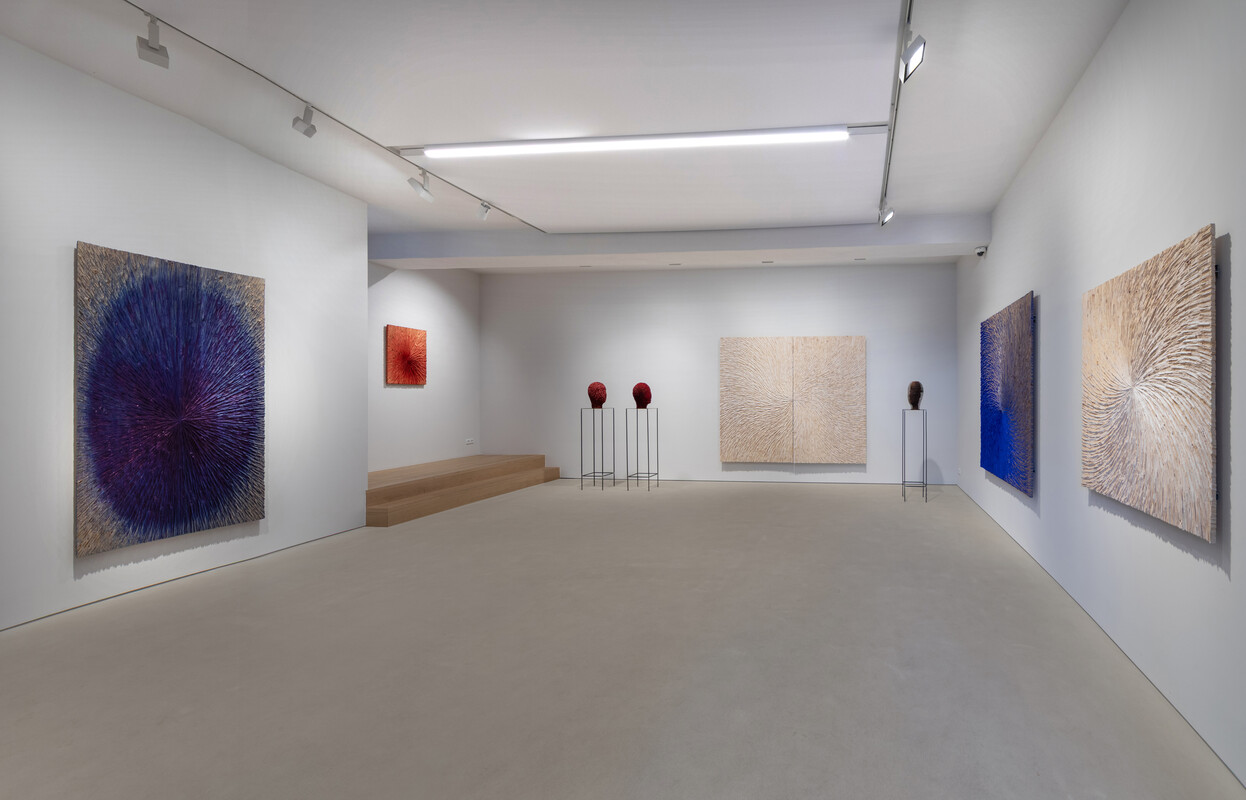
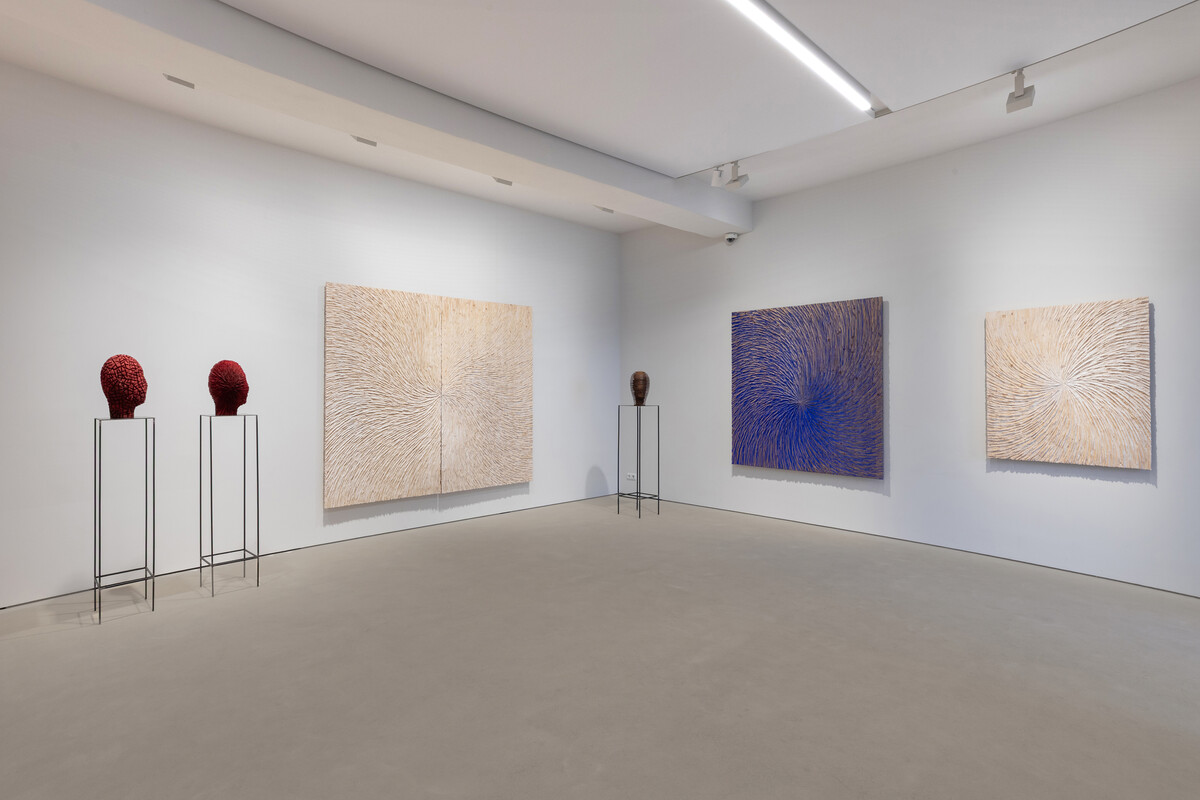
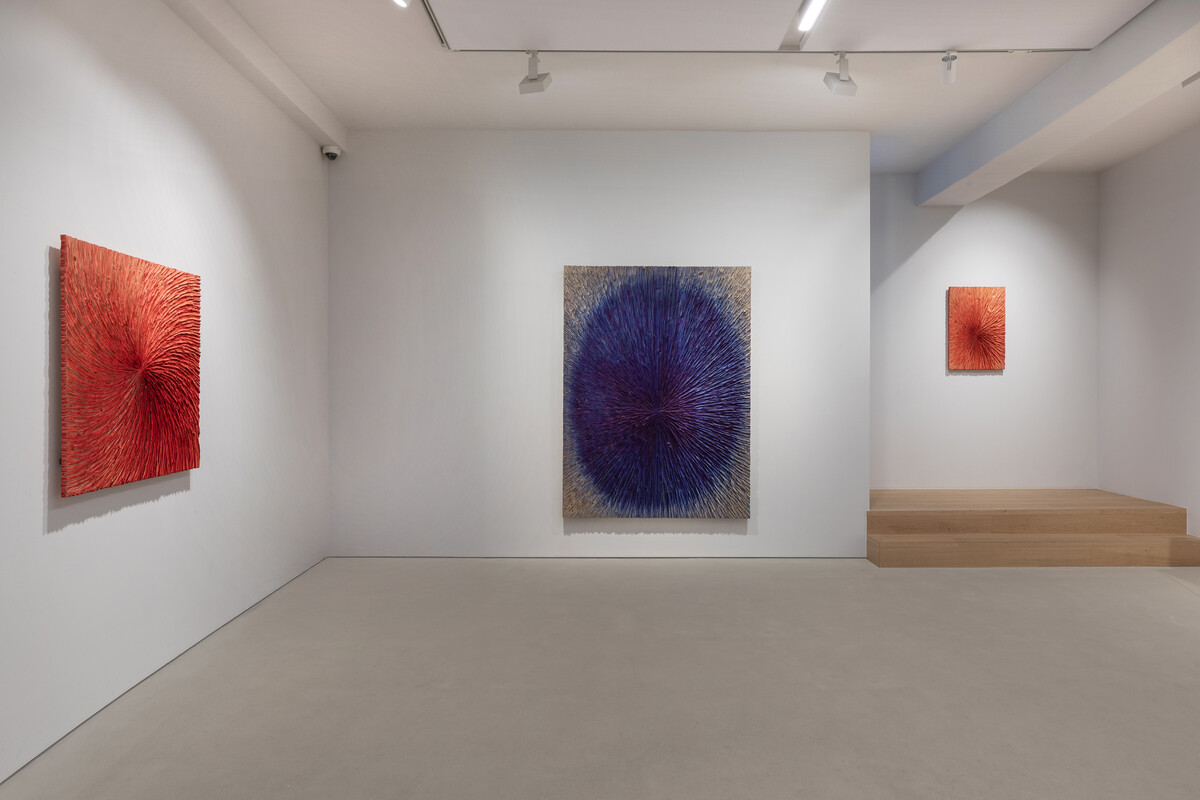
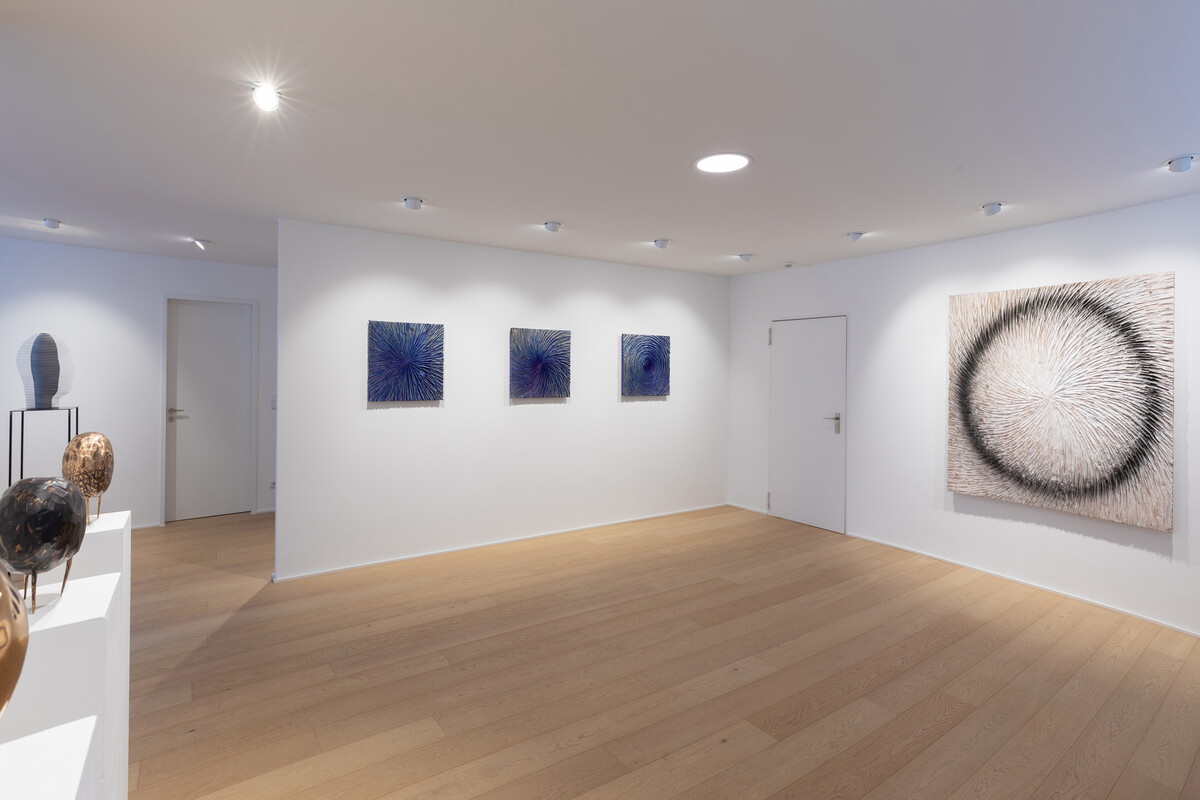
With the exhibition “STRUKTUR TEXTUR RAUM”, Galerie Wolfgang Jahn in Landshut traces the contours of the multifaceted artistic practice of the Austrian sculptor Alfred Haberpointner. At its core are three central bodies of work: the relief-like wooden wall objects whose pictorial surfaces the artist carves with gestural axe blows into rugged, centrifugally drifting formations and whorls, the series of “Heads,” which seem to diffuse into the surrounding space and are at times composed of individual disc-like and void elements, and the group of works titled “Weightings,” massive, ponderous bronze objects balanced precariously on slender, stilt-like legs.
For Haberpointner, the material underlying these works, no matter if it’s wood, steel, or bronze, is never merely a means to an end in the service of sculptural creation. Rather, its inherent qualities, its texture, and its aesthetic value play a decisive role. Even when colour is applied, the material remains visible and tangible. Particularly in his wooden works, Haberpointner speaks of a process of transformation: from organically grown raw material with its specific properties and textures emerges art, a creative attempt to “grant” the material, and thus the work itself, “a new mode of appearance.”
The fundamental principle of sculpture, the interplay and relationship between object and space, is likewise central to his practice. By structuring and rupturing the surface—whether in the wall reliefs, the Heads, or the bulges and cavities of his elevated “Weightings”—Haberpointner creates not only a captivating play of light and shadow. He also achieves a delicate balance between volume and void, mass and fragility, gravity and fineness.
His colour-finished wall objects in spruce wood reveal a relief-like structure shaped by the artist’s hand. Working the surface with an axe, he drives incisions, notches, and fractures deep into the panel. Together with the splinters and ridges left standing, these cuts form a coarse, at times defiant surface of striking tactile intensity. From an originating center, enhanced by color and the pull of shadow, he splinters and fissures the work into radiating, beam-like structures that drift apart in explosive parallel formations. Star-shaped constellations, vortices, and spirals with abrupt shifts in direction emerge, testifying to an extraordinary dynamism and permanently capturing, within the static medium of the object, the full-bodied gestural process of its creation. Counterbalancing the weight of these blocks is the graphic, linear impression left by the carved recesses, lending the works the quality of spatial drawings, at times reminiscent of printing blocks. They also evoke reed-pen drawings, and one may involuntarily recall the swirling clouds in “The Starry Night” by Vincent van Gogh, whose dramatic skies arise from similar graphic gestures. At the same time, the works suggest magnetic field lines, those invisible forces made visible when acting upon materials such as iron filings, arranging them into rhythmically diverging traces.
The literally multilayered series of “Heads” presents de-individualized, anthropomorphic forms that lay claim to universality, independent of cultural identity. As pars pro toto, they stand for human existence and its complex world of thought and emotion, for thinking and feeling itself. Resting upon bases, the heads are self-contained; at times they are structured around an inner core bearing the features of a human face—a head within a head. Frequently composed of lamellar discs stacked at intervals, the forms gradually expand, then taper, tentatively suggesting physiognomic detail. Between the layers, space and air penetrate, so that—particularly when fashioned from steel plates—the Heads convey, in their interplay of material and immaterial presence, a shimmering, vibrating, literally reflective impression that remains elusive and intangible, opening into a free mental space in the truest sense.
On a symbolic level, Haberpointner’s formal structures may be read as metaphor. Space and thus the external world intertwines with the interior of the head—and thus, figuratively, with thoughts and feelings. The device of open form allows diffusion and exchange, reaction and reflection, responsiveness and perception, qualities that define the human mind. At the same time, the opening head forms invite introspection. The embedded head within the head may stand for secret wishes, longings, or even wayward thoughts that often remain hidden within, not directly legible in the outward face.
The series of layered Heads follows a strict, formally rational construction that may evoke associations with cool design objects, but also with engineering and surveying—achievements of the human intellect emblematic of technological progress. One might think of the contour lines of topographical maps, of the model-like character of objects produced by a 3D printer, or of the slice-by-slice imaging of the body in an MRI scanner. The lamellar structures may equally recall sedimentary strata, in which the experiences of a lifetime settle as memories into ever deeper layers of consciousness. And finally, one may be reminded of the concentric growth rings of trees, layer upon layer marking the true passage of time.
Even in the differently conceived Heads of the series, which rest meditatively within themselves, the fascinating element of vitality reveals itself in the textures—be they filigree patterns that seem to lead a vibrant life of their own, enveloping the human exterior like a net, or roughened surfaces that evoke unrest and instability, at times resembling wounds or scars.
The group of works entitled “Weightings” consists of small, patinated or polished bronze sculptures which—like masses mounted on thin pedestals—have a textured surface interwoven with bulges and cavities. One is inclined to perceive organic forms in them, perhaps extraterrestrial life, or to draw comparisons with the humble pill bug. Ultimately, however, the artist is concerned with the phenomenon of statics, the balancing of weight through supporting structures—gravitas and lightness held in tension. The German philosopher and educator Andreas Tenzer once expressed this paradox succinctly: “The heaviness makes the lightness of being bearable.”
Dr. Veit Ziegelmaier